Google

Saturday, April 17, 2010

Poor Growth of Elephant population in North East India

As per the 2007-2008 elephant census, there is a positive growth of the wild elephant population in India i.e. 26413 in 2002 and 27694 in 2007 growing at the rate of 4.85%, but the sad story is that population of wild elephant in North Eastern India has hardly shown any growth.

Wild Population of elephant in North Eastern part was estimated to be 9243 in 2002 while latest estimation in 2007 is 9355, which shows a growth of 1.21%, a sorrow figure.

Three states responsible for such degradation are Meghalaya, Mizoram and Manipur of which Manipur has no wild elephant is left in the state now and Mizoram with just 12 elephants. Meghalaya, on the other hand is de-growing with a rate of 3.05% (1868 in 2002 and 1811 in 2007). Khasi Elephant Reserve in Meghalaya has been accorded by Ministry of Environment & Forests. The State Government is yet to notify.

Assam on the other hand has shown a minor growth in terms of captive as well as wild population but there are other factors which are posing alarming threats to the population.

One of the threats is man-animal conflict which is rising with the increase of elephant population. Other region for such conflict is encroachment of elephant corridors by human.

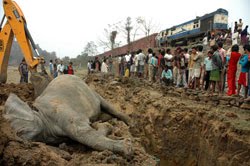
Killing of elephant in Assam is becoming common news, whether it is done deliberately or not. On 25th of October 2009, a male elephant was poisoned by the villagers in Goalpara District. As many as 40 elephants were poisoned to death allegedly by the villagers in 2001. On 28th February 2010, two female elephants were mowed down by goods train. 31 elephants are killed by train since 1998.

“The status of elephant can be the best indicator of the status of the forests.”

Project Tiger

Dear friends! Lets save the elephants before it is too late.

Curtsey: Project Tiger for population data.

Tuesday, August 5, 2008

Critically Endangered Pygmy Hog- Revised

Pygmy hog (Porcula salvania) is an endangered species of small wild pig, previously spread across the terai in India, Nepal, and Bhutan but now only found in Assam. The current world population is about 150 individuals or fewer. Recent conservation measures have increased the prospect of survival in the wild of this critically endangered species


They are about 55 to 71 cm long and stand at 20-30 cm with a tail of 2.5 cm. They weigh 6.6 to 11.8 kilograms. Their skin is dark brownish black and the fur is dark. Piglets are born brown with very faint yellowish stripes along the body length. The head is sharply tapered and they have a slight crest of hair on the forehead and on the back of the neck. Adult males have the upper canines visible on the sides of the mouth. They live for about 8 years, becoming sexually mature at 1-2 years. They breed seasonally before the monsoons giving birth to a litter of 3-6 after a gestation of about 115 days. In the wild they make small nests by digging a small trench and lining it with vegetation. During the heat of the day they stay within these nests. They feed on roots, tubers, insects, rodents, and small reptiles.


The pygmy hog is the sole representative of Porcula, making the conservation of this critically endangered species even more important as its extinction would result in the loss of a unique evolutionary branch of pigs. They used to be widespread in the tall, wet grasslands in the southern Himalayan foothills from Uttar Pradesh to Assam, through Nepal and north Bengal. However, human encroachment has largely destroyed the natural habitat of the pygmy hog by development, agriculture, domestic grazing and deliberate fires. Only one viable population remains in the Manas Tiger Reserve, but even there threats due to livestock grazing, poaching and fire persist. The total wild population has been estimated as less than 500 animals and the species is listed as "critically endangered" (Oliver, 1980; Oliver & Deb Roy, 1993; Pigs, Peccaries and Hippos Status Survey and Action Plan, 1993; Narayan, 2006). Their rarity contrasts greatly with the massive population of wild boars (Sus scrofa) in India.


Conservation of the species has been hampered due to the lack of public support, unlike that for charismatic South Asian mammals like the Bengal Tiger or Indian Rhino. Local political unrest in the area has also severely hampered effective conservation efforts, but these conflicts have now ceased.Pygmy hogs were exhibited in the zoos of London in the 19th century. Neither was captivity aimed at conservation nor did these captive populations survive. Zürich Zoo exhibited pygmy hogs from 1976 to 1978, but all females died. The success of captive breeding dramatically increased after the Pygmy Hog Conservation Programme, PHCP, was established in 1995. The PHCP was established under the umbrella of a formal 'International Conservation Management and Research Agreement' by the Durrell Wildlife Conservation Trust, the IUCN's Pigs, Peccaries and Hippo Specialist Group, the Forest Department, Government of Assam, and the Ministry of Environment and Forests, Government of India. Durrell Wildlife Conservation Trust has launched a comprehensive conservation strategy including field status surveys of pygmy hogs and their habitats, behavioural studies, personnel training, local community awareness and assistance programmes and the establishment of a highly successful captive breeding program at the Pygmy Hog Research and Breeding Centre in Assam. Active habitat management has been established and a reintroduction programme has now been launched (Narayan, 2006).

The Success Story

Dr Goutam Narayan of Durrell Wildlife and EcoSystems-India said,"By 1964, the pygmy hog was thought to be extinct with no sightings reported for several years. Then in 1971, four pygmy hogs were recovered from a market in Paneri in north Assam and that gave everyone cause for hope."

After 12 years of patient conservation effort, which began with six wild pygmy hogs, Assam Forest officials and experts from the Pygmy Hog Conservation Programme (PHCP) have now released 16 hogs into the Sonai Rupai wildlife sanctuary, about 175km (110 miles) north of the state capital, Guwahati. (Reported by BBC News/South Asia;19 May 2008)

Dr Narayan is the man who deserve the credit for the success of the programme.

Assam's chief wildlife warden MC Malakar said,"This is a great day in the history of animal conservation throughout the world and we are proud of the achievement."

This is just the beginning of a new hope to see the pygmy hogs in the wild. But it is only possible with support from each one of us, who has a moral resposibility towards our environment. What we can do is to get more information and inform the ignorant to prevent further damage to the habit of these animals.

Let us Save the Planet which is in CRISIS!

Sunday, August 3, 2008

I am Grateful to the Viewers of My Blogs

This is with reference to blog Critically Endangered Pygmy Hogs.
I am thankful to the viewers of my blog. Today I would like to extend my special thanks to

Dr. Goutam Narayan
Pygmy Hog Conservation Programme
Indira Nagar, Basistha
Guwahati, Assam 781029

I appreciate your concern for correctness of the mentioned article and your effort to inform me.

Tuesday, July 29, 2008

Extinctions will Affect Evolution of Species

Human activities and lack of concern for the environment will lead to the extinction of many species if proper actions were not taken on time. Extinction not only effect the biodiversity of the earth but also effect the complete process of evolution by which biodiversity is created.

According to Norman Myers, a Fellow at Green College, Oxford University,

It takes about 5 million years for the world to recover after a major extinction.

Evolution is being altered by the current extinction.

Certain biomes, such as coral reefs, may lose all of their inhabitants.

Gene pools will be so depleted that species may not be able to bounce back.

Species that have adapted to human environments will dominate.

New species may not evolve if tropical forests disappear.

Loss of species means the loss of sub-species.

Large mammals are likely to go extinct.

The damage caused by the current extinction is probably permanent.

There are so few elephants left, it is unlikely that new elephant species will ever emerge.

What we do now will set a course for evolution.

Thursday, July 17, 2008

Critically Endangered Pygmy Hog


Pygmy hog (Porcula salvania) is an endangered species of small wild pig, previously spread across India, Nepal, and Bhutan but now only found in Assam. The current world population is about 150 individuals or fewer. Recent conservation measures have increased the prospect of survival in the wild of this critically endangered species


They are about 55 to 71 cm long and stand at 20-30 cm with a tail of 2.5 cm. They weigh 6.6 to 11.8 kilograms. Their skin is dark brownish black and the fur is dark. Piglets are born grayish-pink becoming brown with yellow stripes along the body length. The head is sharply tapered and they have a slight crest of hair on the forehead and on the back of the neck. Adult males have the upper canines visible on the sides of the mouth. They live for about 8 years, becoming sexually mature at 1-2 years. They breed seasonally before the monsoons giving birth to a litter of 3-6 after a gestation of 100 days. In the wild they make small nests by digging a small trench and lining it with vegetation. During the heat of the day they stay within these nests. They feed on roots, tubers, insects, rodents, and small reptiles.


The pygmy hog is the sole representative of Porcula, making the conservation of this critically endangered species even more important as its extinction would result in the loss of a unique evolutionary branch of pigs. They used to be widespread in the tall, wet grasslands in the southern Himalayan foothills from Uttar Pradesh to Assam, through Nepal and north Bengal. However, human encroachment has largely destroyed the natural habitat of the pygmy hog by development, agriculture, domestic grazing and deliberate fires. Only one viable population remains in the Manas Tiger Reserve, but even there threats due to livestock grazing, poaching and fire persist. The total wild population has been estimated as less than 150 animals and the species is listed as "critically endangered" (Oliver, 1980; Oliver & Deb Roy, 1993; Pigs, Peccaries and Hippos Status Survey and Action Plan, 1993; Narayan, 2006). Their rarity contrasts greatly with the massive population of wild boars (Sus scrofa) in India.


Conservation of the species has been hampered due to the lack of public support, unlike that for charismatic South Asian mammals like the Bengal Tiger or Indian Rhino. Local political unrest in the area has also severely hampered effective conservation efforts, but these conflicts have now ceased.Pygmy hogs were exhibited in the zoos of London and Berlin in the 19th century. Neither was captivity aimed at conservation nor did these captive populations survive. Zürich Zoo exhibited pygmy hogs from 1976 to 1978, but all females died. The success of captive breeding dramatically increased after the Pygmy Hog Conservation Programme, PHCP, was established in 1995. The PHCP was established under the umbrella of a formal 'International Conservation Management and Research Agreement' by the Durrell Wildlife Conservation Trust, the IUCN's Pigs, Peccaries and Hippo Specialist Group, the Forest Department, Government of Assam, and the Ministry of Environment and Forests, Government of India. Durrell Wildlife Conservation Trust has launched a comprehensive conservation strategy including field status surveys of pygmy hogs and their habitats, behavioural studies, personnel training, local community awareness and assistance programmes and the establishment of a highly successful captive breeding program at the Pygmy Hog Research and Breeding Centre in Assam. Active habitat management has been established and a reintroduction programme has now been launched (Narayan, 2006).

Tuesday, June 10, 2008

A Crime Not Noticed!

It was a few years back; I visited Chennai and its Marina Beach, a memorable experience in itself. What could be a better way of relaxing in a summer evening than to take a walk along the sea-beach? I can remember the day as vividly today as I did on that same day. While I was enjoying my walk, I came across a young kid; he may be fifteen or sixteen years old. He was carrying a bag filled with some coral reef, star fish and sea-shell. He insisted me to buy some as a momentous. I was fascinated by the items in his bag and curious to see more. After a tough bargain over the price, I decided to by a piece of coral reef and two dried up star fish. The beauties of these items were irresistible. Back home they enhanced the beauty of my living room. They often reminded me of that day.

A few days back I learn some more details about coral, and the threats faced by it due to human activities. I did not know that the ocean took thousands of years to produce it so that countless number of other organisms could live with it in a symbiotic relationship. I have taken away a part of it and disturbed the ocean ecology. Like me, there are thousands and thousands tourist who might have taken it as a momentous. If all of us continue to fulfill our greed, it will not be long that the entire coral reef will be destroyed and eventually lead to a disaster in the ocean ecology.

I, now, realize that the kid was doing a crime, and I helped him to do more. I did not notice that I was involved in a crime against the nature. May be the kid did not know what he was doing just like I did.

Now the piece of coral reef in my living room reminds me of the crime every time I look at it and I suffer for the crime I committed.

I am sharing my story so that other should not suffer like I do.

Saturday, June 7, 2008

Fastest Land Animal on Earth is Moving Fast towards Extinction.


I am talking about Cheetah, the fastest land animal which is a critically endangered species in the IUCN Red List of Threatened Animals, especially the Asiatic Cheetah. After the extinction of Indian Cheetah, only the Iranian Cheetah is left with a meager population of 50-60.

It is far more saddening that this animal received its name from the oldest Indian language i.e. from Sanskrit word chitraka meaning “speckled”, yet Cheetah is extinct in India.

Cheetah was always associated with Indian hunting stories. It is said that Emperor Akbar had 1000 hunting cheetah which is depicted in many persian and indian miniature painting. Now though trials are going on to clone the Indian Cheetah and bring back these beautiful animal ,but only increasing the population of Cheetah can not solve the problem. We have to recreate its habitat and also balance the feeding ecology. As Cheetah feed mainly on antelope, so return of Cheetah may lead to extiction of some of these species like the Blackbuck and Nilgai, both are near threaten species.

We, as a superior species than rest, have the moral responsibility to protect all other creature.
Let us do it.

Thursday, June 5, 2008

BAIJI, The goddess of Yangtze is EXTINCT!

Yes, I am going to share sad news today, Baiji, the rare river dolphin of the Yangtze is functionally extinct as reported by the National geographic. According to National Geographic news, Pfluger, a Swiss economist-turned-naturalist who financed the expedition, said in a telephone interview from Wuhan, China, that baiji is functionally extinct.

"If there are any baiji left in the river, they won't have any chance of survival."

This rare dolphin which survived in the Chinese river for more than 20 million years is the first aquatic mammal to go extinct within fifty years due to human activity. The major reason could be the Yangtze dam.

Chinese people, who nicknamed it as the goddess of Yangtze, will never be able to see it or show it to their children. Baiji can not be brought back to existence but at least we can still save the other four types of river dolphins still available in the world from disappearing. Out of these the river dolphins of Brahmaputra and Ganges are in the most critical condition.

I am optimistic that a little effort together can save our River Dolphins.

My Friends, Let us save our Planet!

Thursday, May 22, 2008

Future of Asiatic Lion!


As a small child I was told that Lions are the king of the forest. But, today the situation is very different. Men rule both the cities as well as forest.

Asiatic lions (Panthera leo persica) were believed to rule the forest of India, Pakistan, Afghanistan, Iran, Persia and also the northern part of the African continent.

It was in 1907, the population of Asiatic Lions was found to be only 13 confined to the forest of Gir in India. Now the present population is 360 living in the sanctuary of Gir. It is a great success for the inbreeding program of the sanctuary. But, behind this rosy picture there are other problems that have arisen.

As this entire population of lions descended from a dozen of them left in early 20th century, the DNA fingerprints looks like identical twins, which make them highly vulnerable to any disease.
Beside this, since the entire population is confined to a small geographic area of Gir, any natural disaster could led to the extinction of this sub-species.

Hence the King of the jungle is now vulnerable to biological, climatic and man made catastrophe.

Let us hope that the Samrakshan Trust prepare a second home for the Asiatic Lion before it is too late.

My Friends, Let us save our Planet!

Sunday, May 18, 2008

River Dolphins of India: They are BLIND but are we also?


The Blind River Dolphins, Platanista gangetica, found in Brahmaputra and Ganges rivers. They are also locally known as Hihu and Susu in Brahmaputra and Ganges respectively because of the sound they make while breathing as they are aquatic mammal and need to come out in the surface of the water every 30- 120 second for breathing.

The reasons for loosing their vision are not known but they have highly developed sonar senses.

There are other river dolphins in Yangtse river of China, Indus river of Pakistan and Amazon river of South America.

Though few years back there were many of them, but recent survey conducted in 1993 states that there are only about 600 left in Ganges and 400 left in Brahmaputra and its tributaries like Kulsi and Subansiri. Present number is not known but expected to be much lesser.

The main reasons for such depletion in the number of this unique creature are fishing, poaching and sand mining. Other reason in Ganges is also the damming like Farakka dam.

But, the sad story is that even today not much is done for conservation of this creature and we have also lost our vision just like the Blind River Dolphins. Strict measures are needed immediately.
My Friends, Let us save our Planet!

Thursday, May 15, 2008

Mahatma Gandhi as an Environment Conservator!


Mahatma Gandhi is known as a non violent freedom fighter but we hardly see him as an environment conservator. He had a far sighted approach in every thing he said, he could even visualized the effect of over exploitation of the natural resources and coined this statement in 1909, which holds true in today’s context.


"The earth provides enough to satisfy every man's needs, but not every man's greed.”


“We may utilize the gifts of Nature just as we choose, but in Her books, the debits are always equal to the credits.”


Today, world is facing global warming and climate change, which is the consequence of over exploitation of our natural resources. It has made the climate difficult even for the human species, most adoptable animal of all, to survive. It will lead to extinction some the tropical insects, melting of the glacier at such high rate will lead to drying of some great rivers forever and rise in the sea level will reduce available land for all terrestrial animals and plants.
Now it is the time that we get back to the century old statement and follow it before it is too late.
Let me share some more quotes on nature from the great man:


“This little globe of ours is not a toy of yesterday.”


“I refuse to buy from anybody anything, however nice or beautiful, if it interferes with my growth or injures those whom Nature has made my first care.”


"What we are doing to the forests of the world is but a mirror reflection of what we are doing to ourselves and to one another."


"Wildlife is decreasing in the jungles, but it is increasing in the towns"

Sunday, May 11, 2008

Little Hope for Hoolock Gibbon!

Coming to the biodiversity of the North Eastern states of India, we come across another exotic creature of this region, the Hoolock Gibbon (Hoolock hoolock). Hoolock hoolock is the only species of apes found in India.

Hoolock gibbons face numerous threats in the wild, and are now entirely dependent on human action for their survival. The debilitating threats include habitat encroachment to accommodate ever-growing human populations and immigration, forest clearance for tea cultivation, the practice of jhuming (slash-and-burn cultivation), hunting for food and “medicine”, capture for trade, and the degradation and decline in quality of their forests that impacts fruiting trees, canopy cover and the viability of their home ranges. Isolated populations face the additional threats arising from the intrinsic effects of small populations. Some populations surviving in just a few remaining trees are subjected to harassment by locals and to lack of food, and are attacked by dogs while attempting to cross clearings between forest patches.


Though there is no accurate figure available for the existing Hoolock hoolock but it has been observed that during the last 30-40 years, population of Hoolock hoolock has declined from 100,000 to nearly 80,000 in 1970 and it is now estimated to be some where around 5000 only. And this is a very small number and there is little hope for the Hoolock Gibbon to survive for a long time.


According to IUCN Category of threat (Hilton-Taylor, 2000) Hoolock hoolock falls in endangered (criteria: A1cd).


Thanks to the number of organization and the forest department of Assam that it has declared a Gibbon Sanctuary in Assam. This is just the beginning but more awareness is required for fruitful result.

Asian Elephants are asking for your HELP!


Elephant, world’s largest terrestrial mammal is in grave danger of extinction if we do not take swift action. Though the elephant population of India is showing some growth over sometime as in the graph (shown); the matter of concerns are:


A. The population of Elephant in Assam and adjoining states (North Eastern States), which has the major share (9243 out of 26413), is declining drastically (11023 in 1993 to 9243 in 2002)


B. More concerning fact is the Male: Female ratio, which is alarming due to high number of poaching for the male tusk.


I appeal to the resident of these north eastern states and to the local villagers near these elephant reserves to increase the awareness against poaching and inform the local officials immediately.


If we ignore it now, we will not be able to see the largest terrestrial mammal in the future to come and our children will not see the majestic animal like we did.

My Friends Let Us Save Our Planet and its Treasures.

Where are My Sparrows gone?

Whenever I look at a sparrow (Passer domesticus) , it reminds me of my childhood as I grew up among the sparrows in my house. There were hundreds of them in my roof. But where are my sparrows now? I never realized the number of sparrows in my house was reducing slowly until now that I scarcely able to see any.
I see less number of sparrows every where now. What happened to them?

Being worried, I tried to find out the situation worldwide, and similar situation exist everywhere. May be there are animals who need more attention now but if we leave the situation of these house sparrows unattended now, it may lead to a future concern. I will request a mild effort from every person to save these small creatures, which are facing some problem without our noticing them.

While going deeper into the cause of this problem, I came across one reason which could be the reduced nesting place of these birds. As the old houses are renovated and older nest are being destroyed and newer houses doesn’t provide congenial place for building a nest.
So, Lets take a pledge, that whenever we come across any nest of sparrow, we shall try to protect them.
My Friends, Let Us Save Our Planet.

Saturday, May 10, 2008

Few Words from Mike Pandey!


Mike Pandey’s words…

“Education and awareness and information is the magical key that can bring prosperity, harmony and progress to my country.


The earth is our home and is in a crisis; our collective actions alone can make a difference and give it a chance for revival.


The future is in our hands and we have to leave the legacy of the living world for our children”.

Thursday, May 8, 2008

The Doodle Spot: The Road from Perdition

The Doodle Spot: The Road from Perdition

Are You Suffering From Depression?

According to the National Institute of Mental Health, an estimated 17 million adult Americans suffer from depression during any 1-year period. Depression is a real illness and carries with it a high cost in terms of relationship problems, family suffering, and lost work productivity. Depression can seriously impair a person's ability to function in everyday situations.
Good News is that, depression is a highly treatable illness. Treatment of depression needs involvement of both medicinal as well psychotherapy. Prospects for recovery for depressed individuals who seek professional care are very good. By working with a qualified and experienced therapist, people suffering from depression can help regain control of their lives.

How much sleep do you need?

Everyone’s individual sleep needs vary. It is like number of bread pieces you need for your breakfast. Some of us are fine with just two pieces while other need as many as eight pieces. In general, most healthy adults are built for 16 hours of wakefulness and need an average of eight hours of sleep a night. However, some individuals are able to function without sleepiness or drowsiness after as little as six hours of sleep. Others can't perform at their peak unless they've slept ten hours. And, contrary to common myth, the need for sleep doesn't decline with age but the ability to sleep for six to eight hours at one time may be reduced. (Van Dongen & Dinges, Principles & Practice of Sleep Medicine, 2000)

Three species of Tiger are now Extinct!

Dear friends, when ever I talk of better living, I always talk about improving our environment in which we live. We can do so by preserving the natural environment. It includes both flora and fauna of the place.

Bad news that I am going to share with you is that three species of Tiger are now extinct, they are, Caspian Tigers, Javan Tigers and Bali Tigers. None of us are going to see them and future generation will only hear tales of them.
Few decades before, there were nine different species of Tiger; Bengal tigers are found in Bangladesh, India, Bhutan, Nepal, and Western Burma with a population from 3,000 to as many as 4,050; Siberian tigers or Amur tigers are found in China, Eastern Russia, and parts of North Korea with a population of around two-hundred; Sumatran tigers are found only in Sumatra with a population from four to five- hundred; Indo-Chinese tigers range from Eastern Burma to Vietnam; there are about twenty or thirty South China tigers left in South China; Malayan Tigers, which were identified as different species from Indo-Chinese Tiger only in 2004 and are very few in number less than 500 (estimated); Caspian Tiger, Javan Tiger and Bali tiger which are now extinct.

What Can You Do About It?
You can donate to WWF for Tiger Project. If you can not donate, at least join the Passport program and make a difference.

What YOU get out of it is Satisfaction worth a million Dollars.
My friends let’s Save Our Planet!

Wednesday, May 7, 2008

Mother’s Day is close!

As the Mother’s day closes by I remember an incident that happened nearly a year ago. It was birthday of a friend. I was still confused what gift shall I get for him? At last I got into a Gift shop nearby, so that I could choose one from the collection. There were not many customers out of which a kid nearly eight or nine years old caught my attention. I observed him as he was choosing a Mother’s day card. He picked up a card at last and very happily went up to the counter and poured out everything that he had in his pocket to pay for the card. The shopkeeper counted the change and said that it was not enough to buy that card. The kid was upset and decided to get a smaller card. I was somewhat moved by the sight and decided to help the kid to buy that card. So, I went up to the counter and offered the extra amount and he should buy that card. The Kid refused and replied, “I will get a smaller card, I will not borrow from any one to buy a card for my mother, if you can afford for this then get it for your mother. She will like it.”
I did not say a word and bought the card and he was right. My mother really liked it. That made my day.

The little kid had something to teach me. See if this story has something for you too. If you have not gifted any thing to your mother for some time, then do not miss this opportunity.